Recently one of my coworkers asked something relating to book formats: What is a light novel? This got me thinking that a great idea for a post would be an introduction to formats like manga, its cousins manwa and manhua, and the aforementioned light novels. This can be confusing for newcomers, especially librarians and patrons encountering these differences for the first time. So here's a quick rundown of the comic formats of manga, manwa (as well as webtoons), manhua, and the novel format light novel.
 |
| Welcome to the manga section |
Manga
 |
| Dinosaur Sanctuary, Vol. 5 |
Manga (漫画) is a Japanese word meaning "whimsical pictures" and is used to describe comics originating in Japan. Manga is read from right to left, with spines on the right side of the book. This is because manga follows the tradition of writing text vertically rather than horizontally (horizontal written books are read left to right). Manga is traditionally published in an anthology magazine, like the famous
Weekly Shōnen Jump, published by Shueisha, with a new chapter in each issue. After so many chapters have been published, they're collected in volumes called
tankōbon, much like how American comics are often published in short issues and then gathered into graphic novels, often as trade paperbacks. Manga is generally published in black and white (if color is used, it's usually reserved for just a few pages) and is known for its stylized art, though some series, especially those aimed at adults, use more realistic art. Popular manga are often made into anime.
To the right and below are examples of manga, using the seinen (adult male target audience) series Dinosaur Sanctuary by Itaru Kinoshita.
 |
| Dinosaur Sanctuary vol. 5. Notice that the dialog and pages read from right to left. |
Manwa
 |
The Hellbound
|
Manwa (만화) is the Korean word for comics, coming from the same linguistic root as
manga. Despite being influenced by Japanese manga, manwa has its own style. Manwa tends to be in color and is read from left to right, like an English book, because Hangul, the Korean alphabet, is read left to right like English. While manga is often very stylized, manwa is often more realistic. While its start was in print media, today manwa is largely an online format, with collections like manga's
tankōbon being published physically. Many manwa are published on websites and apps like WEBTOON, Tapas, and Manta. Just like how many popular manga are made into anime, popular manwa are often made into TV series-- often live action K-dramas.
To the right and below are examples from the one manwa I was able to get my hands on today -- The Hellbound by Yeon Sang-Ho and Choi Gyu-Seok. Of course it's black and white rather than color.
 |
| The Hellbound. Notice how this book reads left to right, and how the illustrations are more realistic than the manga example. |
Webtoons
 |
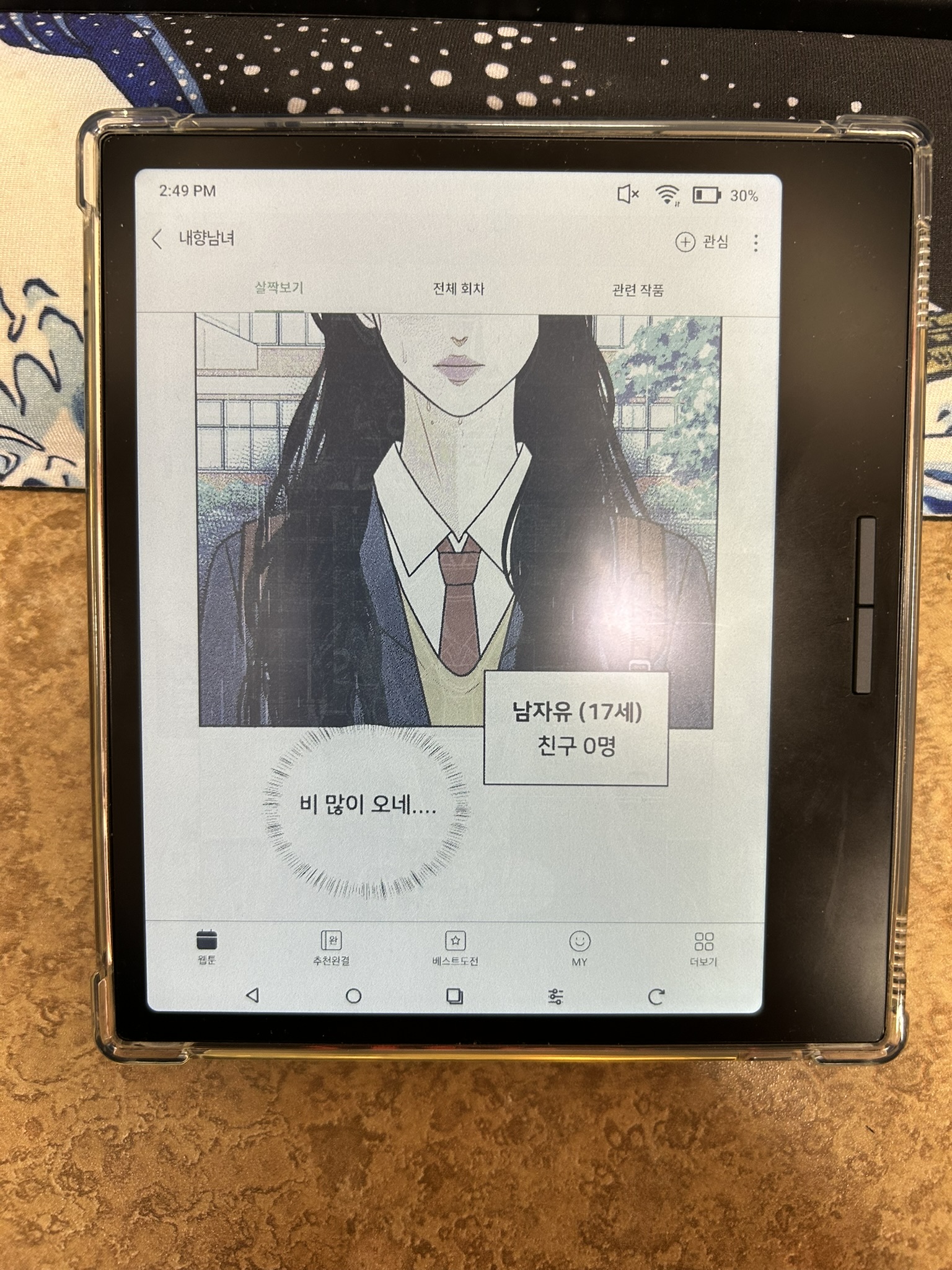
A webtoon on the platform Naver WEBTOON,
displayed on a color e-reader, in Korean. |
In the section above I mentioned that many manwa are initially
webtoons.
Webtoons (웹툰) are online comics that are generally designed for reading on devices like smart phones. Panels are laid out in vertical format to allow easy scrolling. Since they're published online, they're in color. The most popular site/app for webtoons is WEBTOON, owned by the South Korean company Naver. While not all webtoons on the English app are originally Korean (for example, the English-language
Lore Olympus, by an author from New Zealand), a good number are. Popular webtoons often get turned into physical manwa, which are reformatted to flow better as printed books. Thanks to the ease of online distribution, webtoons and manwa have become popular outside of Korea, especially in the United States
Manhua
 |
Grandmaster of Demonic Cultivation, vol. 1
|
Moving over to China we have
manhua (traditional: 漫畫, simplified: 漫画). Manhua has also been growing in popularity in recent years, though it's not yet reached the height of manga or manwa. Like manwa, manhua often starts online on sites like Douban and Weibo. Manhua art tends to be realistic rather than stylized and in full color. They generally are oriented left to right, following the way modern simplified Chinese is read. Popular series have been turned into live-action TV series, or animation called
donghua (which means animation in general, but outside of China specifically means Chinese animation, much like how
anime is used to mean Japanese animation). My example to the right and below is the popular series
Grandmaster of Demonic Cultivation, which began as a webnovel (later printed physically) by Mo Xiang Tong Xiu and has since become a manhua, a donghua, and a live-action TV series.
 |
| A page from Grandmaster. Note the left-to-right speech bubble orientation. |
 |
Two light novels in our collection: Spy x Family: Family Portrait
and Reincarnated As the Last of My Kind |
Light Novels
Light novels (ライトノベル), abbreviated LN, are a kind of novel from Japan. I've heard them described as "like manga, but with fewer pictures/more words." This is incorrect. They're a specific format of novel, rather than sequential art like manga. They're short, usually
about 50,000 words, and have a few illustrations -- often one per chapter. They're generally targeted at young audiences -- teens and young adults. Some light novels began as webnovels, published online -- for example, the popular series Sword Art Online began life as a webnovel before being published physically as a light novel (and receiving manga and anime adaptations). Other light novels are spinoffs of already existing media, auch as Spy x Family: Family Portrait, which is a companion to a popular manga/anime series. Light novels are also infamous for often having very long titles that summarize the plot -- for example, I Parry Everything: What Do You Mean I'm the Strongest? I'm Not Even an Adventurer Yet! is a title of one series.
 |
| Reincarnated As the Last of My Kind is a light novel, so instead of sequential art and speech bubbles, it reads like any other standard novel. |
Hopefully this introduction helps anyone who has come across requests for light novels, or has wondered what the difference between manga and manwa is. Feel free to post any questions you may have, I'm my library's selector for these formats.